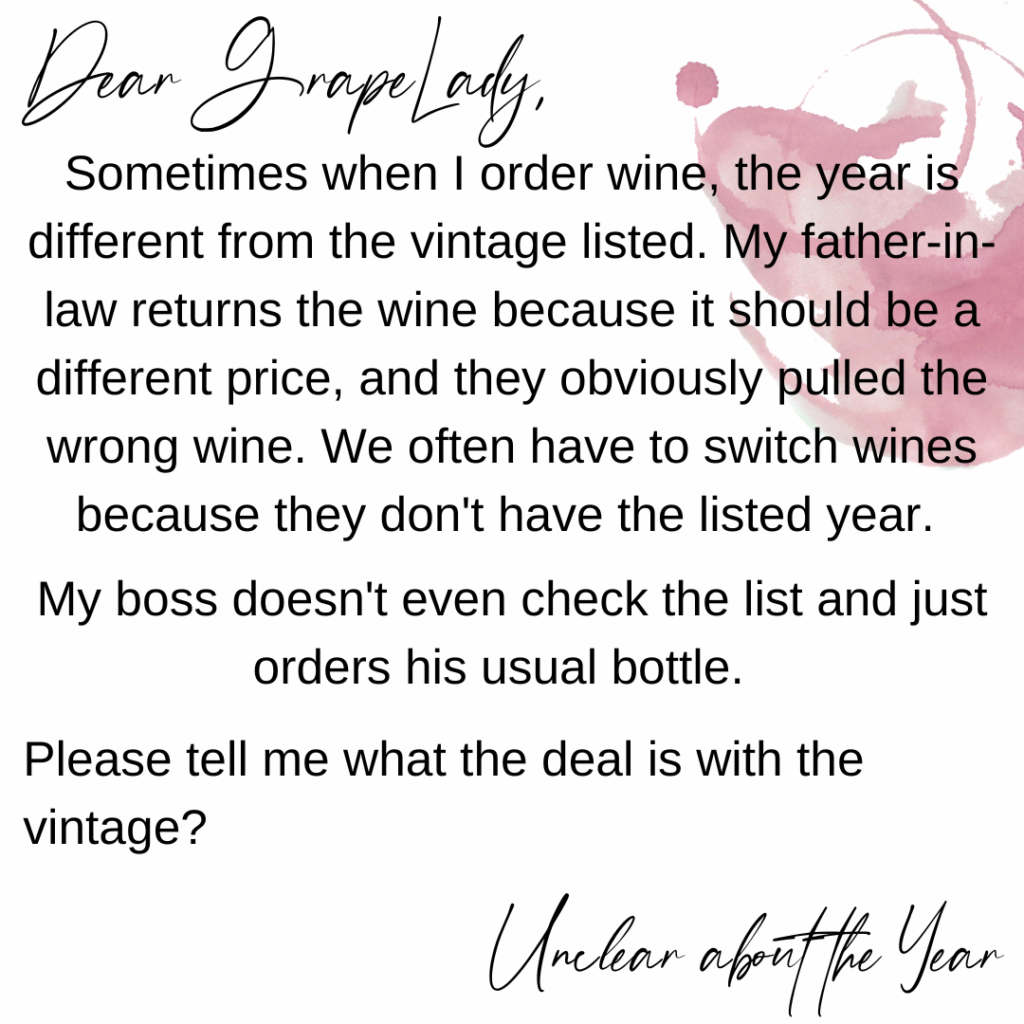
Dear Unclear,
Vintage matters, sometimes more than others. Clear as mud, huh?
Both your father-in-law and your boss are right in some situations, but also unhelpful. Let me clarify.
Vintage refers to the year in which the grapes used to make the wine were harvested. There might be some flexibility in labeling depending on where the grapes are grown and where the wine is from. In the United States, 95% of the grapes used in the finished wine must be from the listed year. In Chile and South Africa, the requirement is only 75%, while the European Union member states, New Zealand, and Australia all sit in the middle at 85%. This flexibility allows winemakers to blend in wine from a previous year, which can improve a wine from a challenging season.
For example, if the harvest is rainy and wet, the grapes are likely to swell with excess water or contract fungal diseases (which taste awful). This would require meticulous hand-sorting of the grapes to remove the damaged ones. Not many grapes make it through this selection process, and the ability to add a bit of last year’s wine to the final blend can enhance its quality and increase the production volume.
So, if you order a 2016 Chateau Montelena Chardonnay from Napa Valley, and they bring you the 2017 vintage, I wouldn’t fuss. Vintages in regions like Napa Valley, known for their consistent sunshine, don’t typically vary dramatically in quality or price. Winemakers are more likely to produce less wine than to make a lower-quality product.
However, if you order a 2014 Domaine Quivy, Charmes Chambertin, Grand Cru, and they bring you the 2005, it’s a good idea to ask the server to double-check. Burgundy, for instance, is often plagued by adverse weather conditions, so vintages there can vary significantly in quality and price.
This is confusing- so a base line rule- if the wine list has multiples of the same vintage and you selected a specific one- always comment. If you ordered an inexpensive bottle – be prepared that the vintage may be different- wines that sell the most are most likely to have a vintage change. It is acceptable to saw you would prefer something else if yoyu have a vintage preference, but always be polite about it.
Lastly, don’t be too critical if the sommelier brings you a different bottle with an apology for the vintage change. Suppliers usually don’t inform buyers about vintage changes in advance. Be polite and understanding. Managing a wine list can be quite a task, and there’s a lot more that goes into running a beverage program than meets the eye.
Cheers,