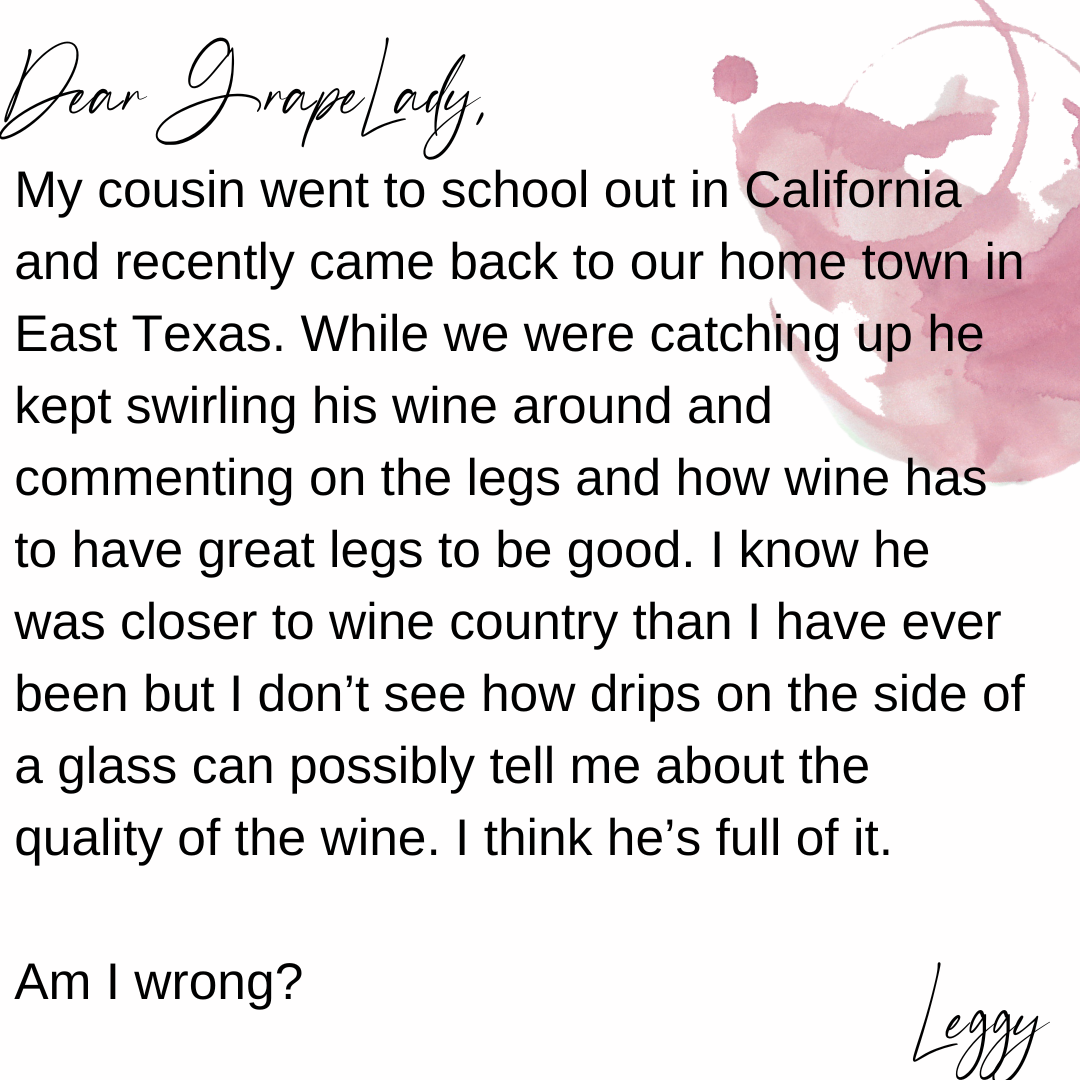
You’re right. Going to school in California doesn’t make your cousin a wine expert. Just like growing up in Texas doesn’t mean that I rode a horse to school. Legs don’t tell you anything about the quality of the wine- they can give you clues about the wine’s identity but that is all.
Legs are defined as the drips that come down the interior of the wine glass when the wine is swirled. Often the comment of a wine having ‘great legs’ is just a safe ‘something’ to say about the wine. The speed at which a wine’s legs fall down the interior of the glass does not indicate quality– it indicates thickness of the liquid, thicker liquid forms thicker legs that fall slower. That thickness may be due to alcohol or sugar. The legs are not an indicator of price or quality. In professional blind tastings we check them as they may be a clue to if the wine is higher alcohol or sweet, but we don’t make a judgment without smelling and tasting.
Just like people, what you see is not always what you get. Just like people, visual indicators are not the most important aspect of wine. If you want to have a more nuanced conversation about wine, sniff it and talk about what you smell. The average human nose can differentiate between a trillion different scents. And say, ‘not me’ consider: What does your mom’s house smell like? What does lemon juice smell like? Lime juice? Orange juice? Roses? Burning rubber? Pencil lead? You can conjure all those in your head- there are many more. But how often in life do you pause and name all the smells around you? Probably never? If you don’t feel like you ever smell anything but wine, try comparative sniffing. Smell the strawberry jam in the fridge, then sniff your glass of red- do you find it there? Try the black peppercorns and your glass of Syrah. It’s like those hidden picture games, once you smell it, you won’t be able to not.
So instead of commenting on the wines’ legs, comment on what is in the glass. It will be a more interesting conversation,
Cheers,