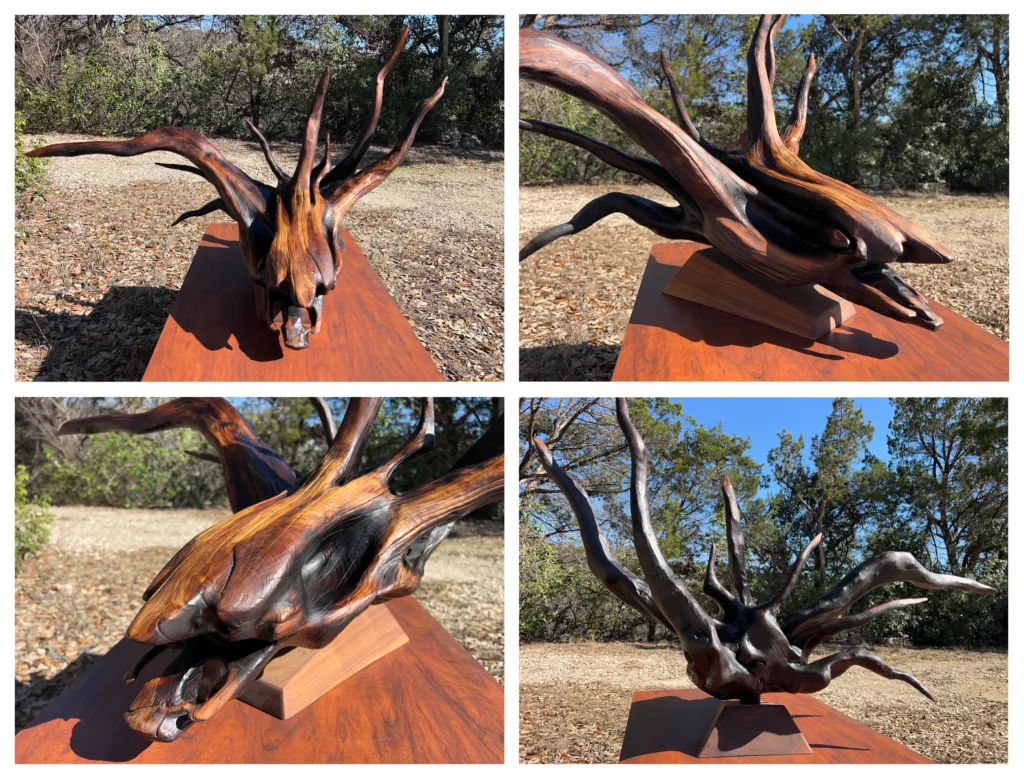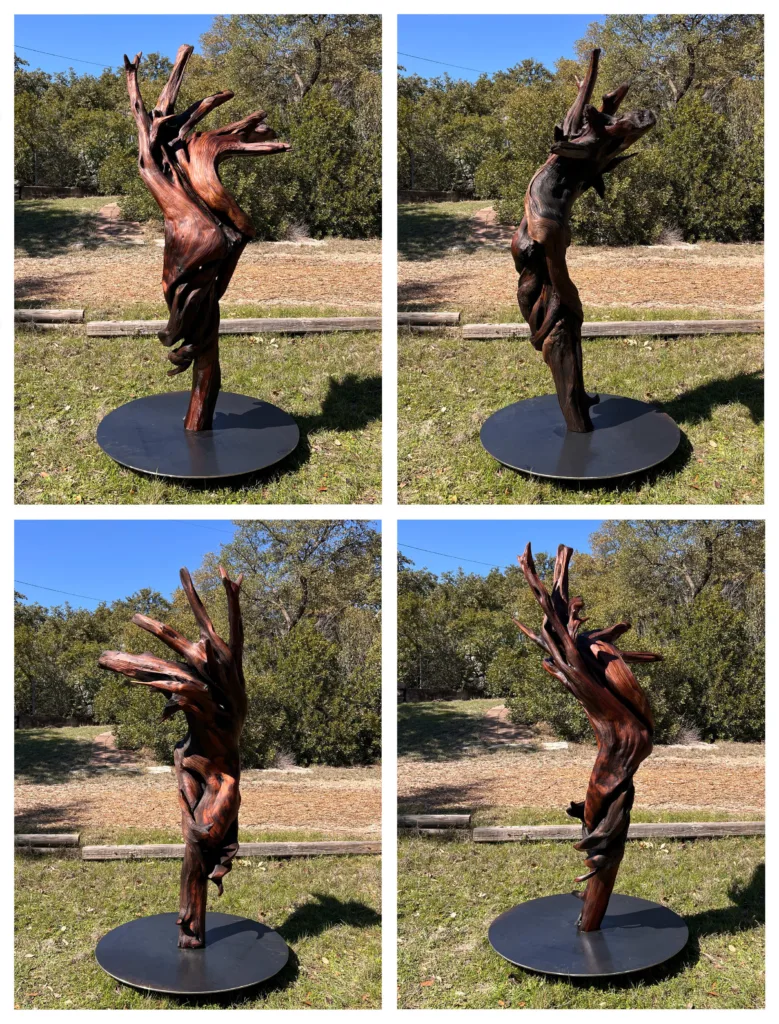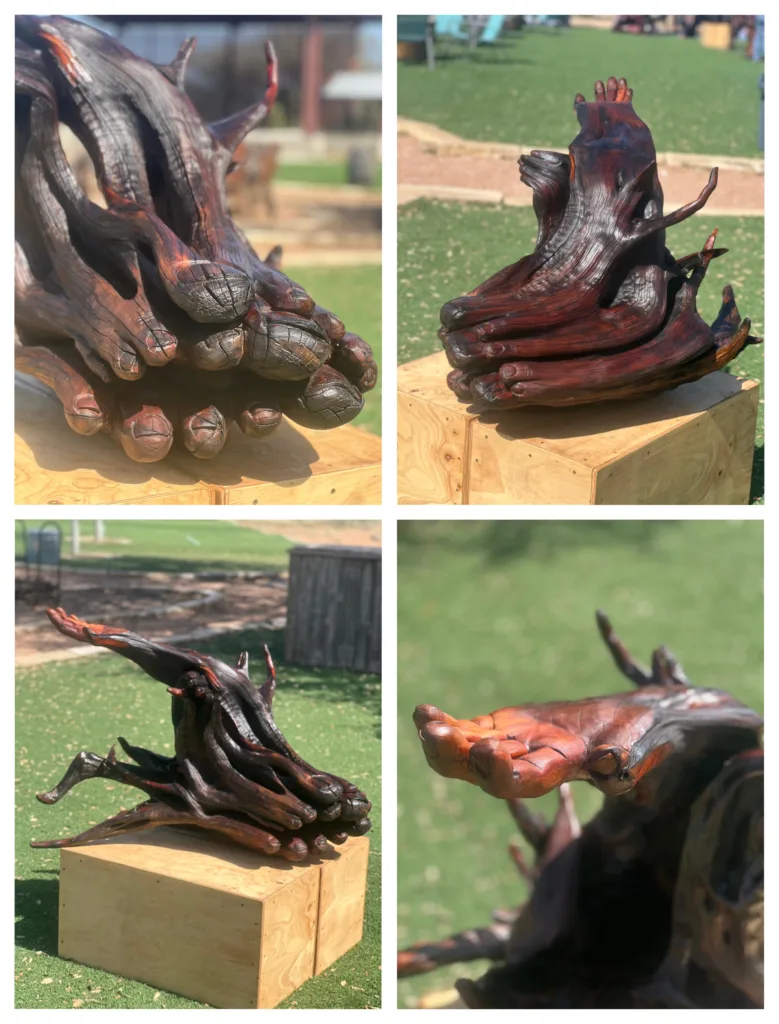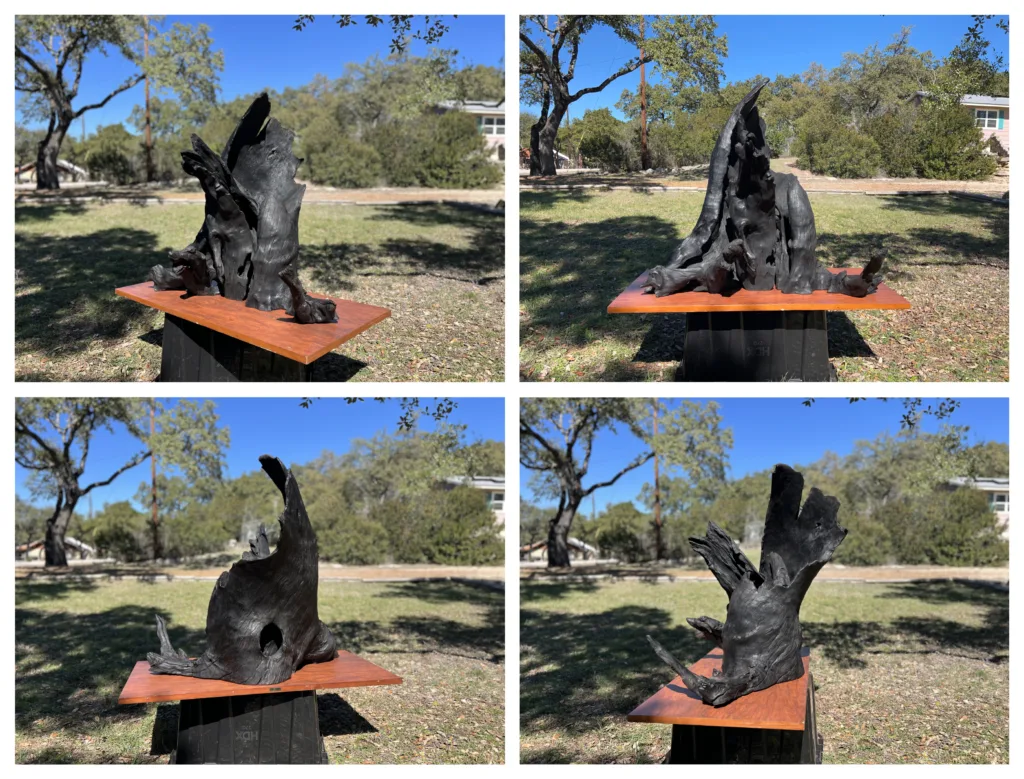
Vasho’s work begins where most people stop looking.
Across from his workshop in Leander, Lake Travis recedes and rises, exposing remnants of a valley that disappeared when the dam was built decades ago. Trees were cut and left behind. Stumps and logs sit submerged underwater for more than 80 years. Preserved rather than rotting, the wood waits.
Vasho walks the shoreline frequently, often with his family. Driftwood. Massive stumps. Pieces shaped not by tools, but by time, water and circumstance. What looks like debris to most feels like treasure to him. New pieces wash ashore as the lake shifts, offering material that is always changing.
Born, raised and trained in Slovakia, Vasho began carving wood early, completing his first sculptural piece around the age of fourteen. He goes on to study sculpture at the university level, spending time in galleries and learning a distinction that still guides his work today: the difference between art and craft. Craft serves function. Art exists for its own sake, defined by intention, technique and artistic value.
Though his family were tailors by trade, creativity runs through generations. His father is a talented sketch artist, and an uncle works as a wood carver. Long before Lake Travis enters the picture, Vasho is already drawn to working with natural materials.
Much of the wood he works with is red oak and cedar, hardwoods that do not rot underwater. Red oak, in particular, becomes even denser after sitting submerged for decades, almost petrified by time. The pieces he retrieves carry weight, both physically and historically.
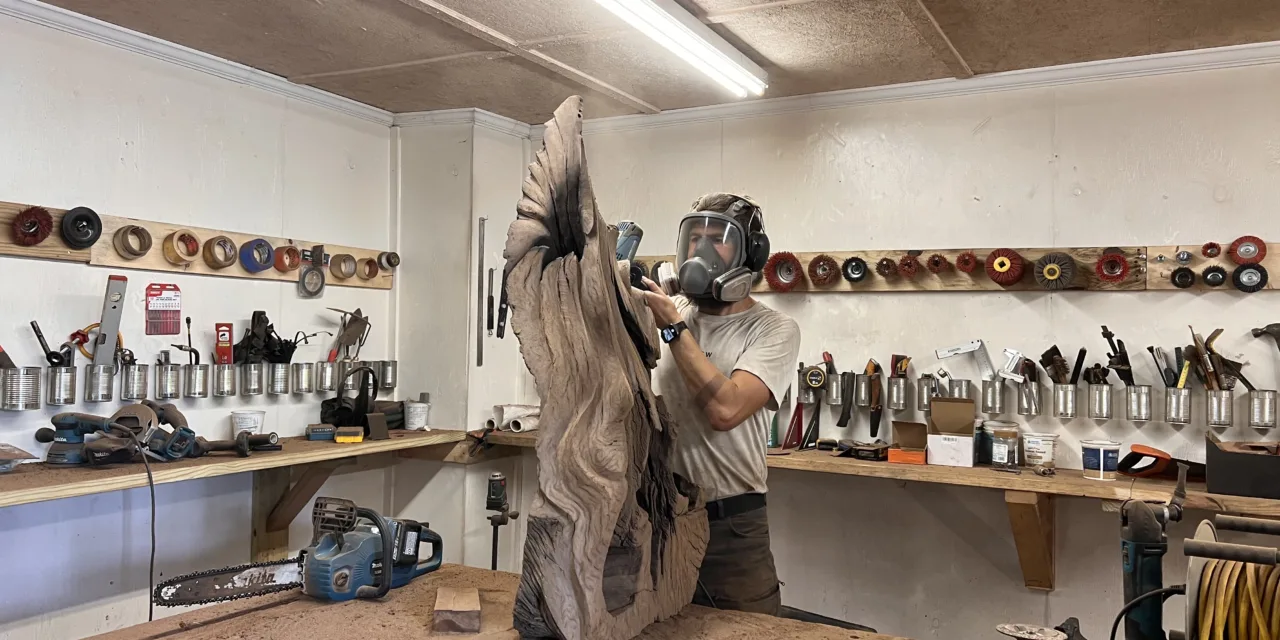
Vasho does not force ideas onto the wood. More often than not, the process itself reveals what a piece wants to become. Cleaning, burning, grinding and brushing bring out details that guide the work forward. Nature remains the lead artist. He simply follows.
Inside his workshop, the tools reflect that philosophy. Sanding, polishing or leaving a piece raw are all options, but one of his preferred techniques is brushing with nylon brushes. Unlike sanding, nylon brushing lifts the grain instead of flattening it, revealing texture and depth that might otherwise be lost. It is a subtle choice, but one that allows the character of the wood to speak more clearly.
Fire is another part of the process. Using a propane torch, Vasho burns sections of the wood, not to erase, but to emphasize. Burning deepens contrast, highlights form and adds another layer of history to material that already carries decades of it.
Outside his shop, unfinished pieces are scattered. Wood he has not yet found direction for. Some may wait months. Others, years. The work develops in stages, often guided by time rather than urgency.
There is no rush in his work. No repetition for the sake of production. Each piece develops on its own timeline.
Vasho has been in the United States for just one year, living in Leander with his wife and two children. His proximity to the lake allows him to return to the shoreline often, continuing the quiet practice of looking, collecting and waiting for the right moment.
In his hands, wood shaped by water and time becomes something deliberate, still bearing the marks of nature, but guided into form with restraint and respect. It is work rooted in patience, history and an understanding that sometimes the most important part of making art is knowing when not to interfere.
See more of Vasho’s work on hist instagram